
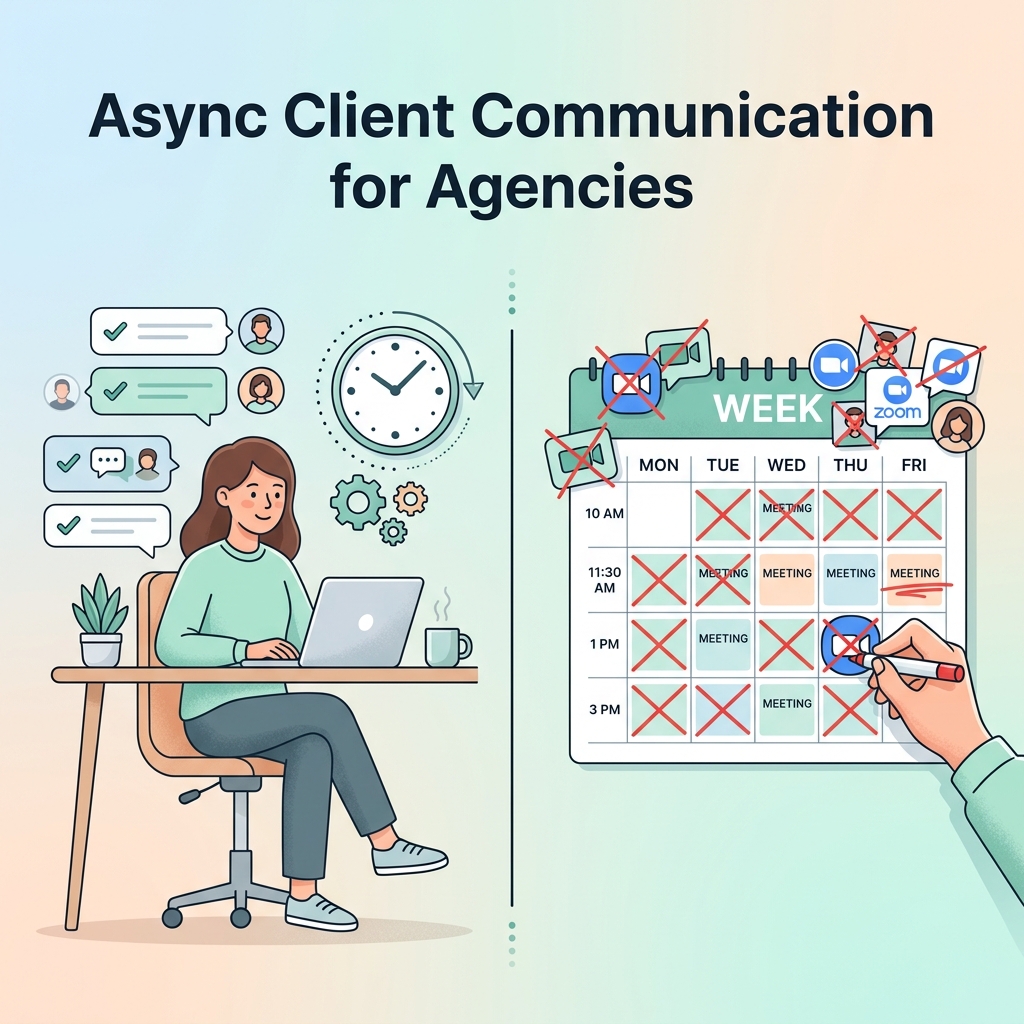
I once worked with an agency owner who had 23 client calls scheduled in a single week.
Twenty-three.
He wasn't running a massive enterprise agency. He had nine clients, a team of four, and a calendar that looked like a game of Tetris designed by someone who hates free time. Most of those calls were "quick check-ins" and "feedback syncs" and "just wanted to align on a few things." None of them were necessary. All of them were destroying his ability to do actual work.
When I asked him why he had so many calls, his answer was immediate: "Clients expect it. If I don't hop on a call, they'll think I'm not paying attention."
He was wrong. His clients didn't need more meetings. They needed a better system. And the moment he gave them one, the calls dropped to four per week, client satisfaction went up, and his team finally had time to think.
That's what asynchronous communication does. It doesn't replace relationships. It protects them from being drowned in unnecessary real-time interaction.
Why Synchronous-by-Default Is Wrecking Your Agency
Let's be honest about why most agencies default to calls and meetings: it's easier to schedule a call than to build a system.
Hopping on a call feels productive. You're talking, they're responding, things are moving. But here's what's actually happening:
You're trading depth for speed. When everything is a live conversation, decisions happen fast but without reflection. Clients agree to things on a call they'd push back on if they had time to think. You commit to timelines you'd reconsider if you checked your capacity first. Speed without consideration creates rework.
You're creating invisible bottlenecks. If all feedback goes through calls, nothing moves until everyone is in the same room at the same time. A client in a different timezone, a stakeholder who's traveling, a team member who's in another meeting — each one stalls the entire project until the stars align.
You're exhausting everyone. Meeting fatigue isn't a buzzword. It's what happens when creative professionals spend their mornings in back-to-back calls and are then expected to produce brilliant work in the afternoon with whatever mental energy they have left. Which is none.
The fix isn't "ban all meetings." The fix is "stop defaulting to meetings when a better format exists."
What "Async-First" Actually Means
Async-first doesn't mean async-only. It means you start by asking: "Does this need to happen in real time?" If the answer is no, you use an asynchronous method. If the answer is yes, you schedule a focused call with a clear agenda.
Here's a practical framework for deciding:
Use Synchronous Communication For:
- Kickoff calls. Building rapport and establishing the relationship.
- Strategy sessions. Complex decisions where live brainstorming adds value.
- Conflict resolution. Sensitive topics that benefit from tone and nuance.
- Celebrations. Wrapping up a project, reviewing results, saying thank you.
Use Asynchronous Communication For:
- Status updates. "Here's where things stand" doesn't need a meeting.
- Feedback on deliverables. Clients give better, more specific feedback when they can take their time.
- Approvals. A clear "Approved" or "Changes Requested" action is faster and more documented than a verbal yes on a call.
- Questions and clarifications. 90% of questions can be answered in writing, with the added benefit of creating a searchable record.
- File sharing and review. Sending work for review should never require scheduling a call.
When you map your client communication against this framework, most agencies discover that 60-70% of their meetings should have been messages, updates, or structured feedback sessions.
The Async Communication Stack
Going async isn't about picking one tool. It's about building a system where each type of communication has a clear home.
Layer 1: A Structured Review Portal
This is the big one. The single change that eliminates the most unnecessary meetings is giving clients a dedicated place to review work and provide feedback on their own time.
Instead of scheduling a call to "walk through the deliverables," you send a link. The client opens it when they're ready, reviews each item at their own pace, leaves specific comments tied to specific elements, and either approves or requests changes.
No scheduling conflicts. No "sorry, can we push this to next week?" No 30-minute call where the first 15 minutes are small talk.
The key is that the system must be frictionless for the client. If they need to create an account, learn a new tool, or navigate a complicated interface, they'll just ask you to hop on a call instead. The system needs to be as simple as opening a link.
Layer 2: Async Video for Context
Some things are hard to explain in writing. Walkthroughs, strategic rationale, and complex updates benefit from the richness of video.
The solution isn't a meeting, though. It's a recorded video. Tools like Loom let you record a five-minute walkthrough that the client can watch at 2x speed on their lunch break. They get the context they need without blocking 30 minutes on both your calendars.
Use async video for:
- Walking clients through a project milestone
- Explaining the reasoning behind a creative direction
- Demonstrating how to use a deliverable
- Providing a weekly progress update
The client watches it when convenient, and you've eliminated a meeting while giving them more context than a written message could provide.
Layer 3: Threaded Messaging for Everything Else
Quick questions, clarifications, and day-to-day chatter belong in a messaging tool with threads. Slack is the default, but the tool matters less than the discipline.
The rule is simple: every topic gets its own thread. Never ask a question about the homepage redesign in the middle of a thread about the social media calendar. When topics stay organized, information stays findable.
Set clear response time expectations with clients. "We'll respond to messages within one business day" is a perfectly reasonable standard that gives your team breathing room and gives the client predictability. Most clients don't need instant replies. They need reliable ones.
How to Transition Existing Clients to Async
You can't just email your clients and say "we're doing async now, no more calls." That's a recipe for confusion and distrust. The transition needs to be gradual, explained, and demonstrated.
Step 1: Introduce the System
At the start of your next project or milestone, introduce your new feedback process:
"We've set up a review portal for you. When deliverables are ready, I'll send you a link. You can review everything, leave comments directly on the work, and approve or request changes — all without scheduling a call. It usually takes our clients about five minutes."
Position it as a benefit to them, not a change for your convenience. They save time. They can review when it suits their schedule. Their feedback is more organized.
Step 2: Replace the "Feedback Call" First
The lowest-hanging fruit is the feedback meeting. Instead of scheduling a call to review deliverables, send the review link with a brief async video walkthrough.
Most clients will adapt immediately. When they realize they can review work on their lunch break instead of blocking an hour on their calendar, they prefer it.
Step 3: Reduce Meetings by One Per Cycle
Don't eliminate all meetings at once. Each project cycle, replace one meeting with an async alternative. The weekly status call becomes a written update. The revision review call becomes a portal session. Gradually, clients adjust to the new rhythm without feeling abandoned.
Step 4: Keep One Anchor Meeting
Even in a fully async workflow, maintain one regular synchronous touchpoint. A bi-weekly or monthly strategy call keeps the human connection alive and gives both sides a chance to discuss bigger-picture items that don't fit neatly into a portal or message thread.
The anchor meeting is short, focused, and valuable because it's the only one. When you have 12 meetings a month, each one feels disposable. When you have two, each one matters.
Handling the "But My Clients Want Calls" Objection
Some agency owners resist going async because they believe their clients specifically want frequent calls.
Sometimes that's true. Some clients are relationship-oriented, and they value face time. Those clients should get calls. Not every client interaction needs to be async, and forcing it when the client is clearly uncomfortable will hurt the relationship.
But most of the time, clients request calls because they don't have an alternative. They've never been offered a better system. When "hop on a call" is the only option, that's what they'll choose. Give them a system that's faster and easier, and most of them will switch without complaint.
The proof is in the response time. Agencies that adopt async client feedback tools typically see feedback turnaround drop from an average of 5-7 days to 1-2 days. That doesn't happen because async is less personal. It happens because async removes the scheduling bottleneck that was causing the delay in the first place.
The Async Communication Cheat Sheet
Here's a quick reference for your team:
| Situation | Format | Tool |
|---|---|---|
| Sharing deliverables for review | Structured review link | Client portal |
| Explaining creative direction | Recorded walkthrough | Async video (Loom) |
| Weekly project update | Written summary | PM tool or email |
| Quick question | Threaded message | Slack/messaging |
| Complex strategy discussion | Scheduled call (with agenda) | Video call |
| Approval or rejection | Structured action | Client portal |
| Post-project retrospective | Scheduled call | Video call |
The key insight is that the format should match the content, not the urgency. "The client wants this today" doesn't mean "schedule a call today." It means "send the review link today."
Async Is Faster. Not Colder.
The fear behind the resistance to async is that clients will feel neglected. That removing meetings means removing care.
The opposite is true. Clients feel neglected when their feedback goes unaddressed for a week because nobody could find a time that worked for a call. Clients feel cared for when their feedback is responded to within hours because the system doesn't depend on calendar availability.
Async communication isn't about doing less. It's about removing the waiting. And in client work, waiting is where trust dies.
Start by replacing one meeting this week. Send a review link instead of scheduling a call. Watch what happens.
Need a frictionless way for clients to review and approve work asynchronously? TryApprove lets you share deliverables with a link — no client accounts required. They review, comment, and approve on their own schedule.
Want to rethink your feedback process entirely? Read about why chasing clients for feedback is a symptom, not the problem.