
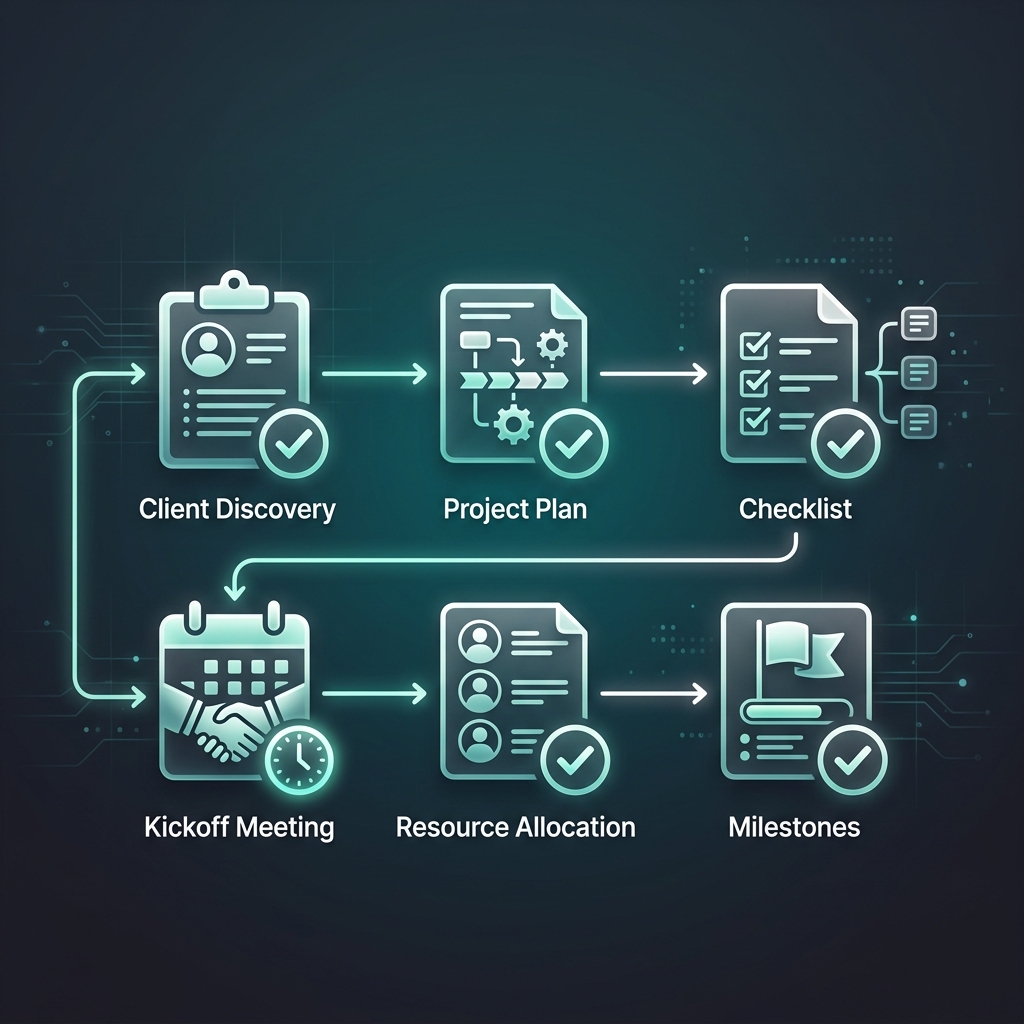
The first 48 hours of a client project determine 80% of its outcome.
That might sound dramatic, but think about it. In those first two days, you either:
- Set clear expectations — or leave them ambiguous
- Establish a professional workflow — or default to chaos
- Build trust through preparation — or erode it through improvisation
- Align on creative direction — or start guessing
Most agencies don't have a formal kickoff process. They have a casual call, take some notes, and start working. Six weeks later, they're wondering why the client is unhappy with the direction, why scope has crept, and why approval is taking forever.
This post gives you the complete toolkit — templates, checklists, and scripts — to run a kickoff that sets every project up for success.
Part 1: The pre-kickoff intake questionnaire
Before the kickoff call, send the client an intake questionnaire. This serves two purposes: it collects the information your team needs, and it forces the client to think through their requirements before the conversation.
Brand & design project intake template
PROJECT OVERVIEW
1. What is the primary goal of this project?
   (e.g., rebrand, new product launch, website redesign)

2. What does success look like? How will you measure it?

3. Is there a hard deadline? If so, what's driving it?
   (e.g., product launch date, conference, board presentation)

AUDIENCE
4. Who is the primary audience for this work?
   (Age, industry, role, pain points)

5. How do you want your audience to feel when they see this?

6. Are there any secondary audiences to consider?

BRAND CONTEXT
7. Do you have existing brand guidelines? (Please share)

8. What 3 words best describe your brand personality?

9. Are there brands you admire (in any industry)? Why?

10. Are there visual styles or approaches you specifically
    want to avoid?

PRACTICAL DETAILS
11. What deliverables do you expect from this project?
    (List everything you're expecting to receive)

12. Who are the decision-makers for this project?
    (Name and role of each person who needs to approve work)

13. How do you prefer to give feedback?
    □ Written comments on designs
    □ Voice notes or Loom videos
    □ Live calls
    □ Any of the above

14. What went well with your last designer/agency?

15. What went poorly with your last designer/agency?

16. Is there anything else we should know?
Marketing & content project intake template
PROJECT OVERVIEW
1. What is the primary business objective?
   (e.g., increase leads, build brand awareness, launch product)

2. What metrics will you use to measure success?

3. Is there a campaign or launch date we're working toward?

AUDIENCE
4. Describe your ideal customer in one paragraph.

5. What problem does your product/service solve for them?

6. Where does your audience spend time online?
   (Social platforms, blogs, forums, etc.)

COMPETITIVE LANDSCAPE
7. Who are your top 3 competitors?

8. What do they do better than you? What do you do better?

9. How do you want to differentiate in this project?

BRAND VOICE
10. Describe your brand voice in 3–5 adjectives.

11. Share 2–3 examples of content you've published
    that you love.

12. Share 1–2 examples of competitor content that
    resonates with you.

PRACTICAL DETAILS
13. What content/assets do you already have that
    we can use? (Photos, videos, copy, logos, etc.)

14. Who needs to approve the final deliverables?
    (Names and roles)

15. What tools do you currently use for marketing?
    (Email, social scheduling, analytics, etc.)

16. Anything else we should know?
Pro tip: Don't send these as Google Forms or email attachments. Use a client portal that includes questionnaires as part of the onboarding flow. TryApprove lets you add intake questionnaires directly to the client's portal — they fill it out alongside signing the contract and reviewing welcome documents, all in one place, no signup required.
Part 2: The kickoff meeting script
The kickoff isn't a re-discovery call. If you've done the intake questionnaire correctly, you already have the information. The kickoff is about alignment, relationship-building, and setting the rules of engagement.
Kickoff meeting agenda (30–45 minutes)
1. Welcome & introductions (5 minutes)
"Thanks for joining, [Client Name]. We're excited to kick this off. Let me quickly introduce the team working on your project..."
Introduce each team member by name and role. If the handoff from sales happened, this is where the delivery lead takes ownership.
2. Confirm understanding (10 minutes)
"I've reviewed your questionnaire and our proposal. Let me walk through what I understand so far, and you tell me if anything's off..."
Summarize:
- The project goal (in one sentence)
- Key deliverables
- Timeline and milestones
- Success criteria
This isn't about reading the proposal back to them. It's about demonstrating that you listened and understood. Let the client correct or add nuance.
3. Set the workflow (10 minutes)
"Here's how we'll work together over the next [timeline]..."
Cover:
- Communication: "All project updates, deliverables, and feedback will happen through your client portal. I'll send you the link right after this call."
- Review process: "When we have something ready for review, you'll get a notification. You can open it in your portal, leave comments directly on the design, and approve or request changes with one click."
- Revision rounds: "We've scoped [X] rounds of revisions. Here's how we define a revision round versus a new scope item."
- Response times: "We'll respond to portal feedback within [X] business hours. We'd love for your team to review deliverables within [X] business days so we can keep the timeline on track."
4. Walk through the portal (5 minutes)
"Let me give you a quick tour of your project portal..."
Share your screen and show:
- Where deliverables will appear
- How to leave feedback (visual annotations)
- How to approve or request changes
- Where contracts and questionnaire responses are stored
- Where invoices will appear
This 5-minute walkthrough prevents a dozen "where do I find X?" emails later.
5. Discuss creative direction (10 minutes)
"Based on your questionnaire, I have a few questions about direction..."
This is where you ask the 2–3 clarifying questions that the intake didn't cover. Keep it focused — this isn't a full discovery session.
6. Confirm next steps (5 minutes)
"Here's what happens next..."
- Next milestone and date
- What you need from the client (if anything)
- When they'll see the first deliverable
"Any questions from your side?"
End on a confident, forward-looking note. The client should leave feeling organized and optimistic.
Part 3: The project charter template
After the kickoff, create a one-page project charter. This is the "rules of engagement" document that both sides reference throughout the project.
PROJECT CHARTER

Project: [Name]
Client: [Name]
Agency lead: [Name]
Start date: [Date]
Target completion: [Date]

---

PROJECT GOAL
[One sentence describing what success looks like]

---

DELIVERABLES
1. [Deliverable 1] — Due [Date]
2. [Deliverable 2] — Due [Date]
3. [Deliverable 3] — Due [Date]

---

REVISION POLICY
- Included: [X] rounds of revisions per deliverable
- A "round" is defined as: one consolidated set of
  feedback submitted within [X] business days
- Additional rounds: billed at $[X] per round

---

COMMUNICATION
- Primary channel: Client portal ([link])
- Internal team: [Slack/email — not shared with client]
- Escalation: Email [agency lead] for urgent issues
- Response time: Agency responds within [X] business hours;
  client reviews within [X] business days

---

APPROVAL PROCESS
- Deliverables are submitted via portal
- Client reviews and leaves feedback via visual annotations
- One-click "Approve" or "Request Changes"
- Approved deliverables are considered final

---

TIMELINE RISKS
- Client delays in feedback extend the project timeline
  by an equivalent number of business days
- Scope changes require a written change order and may
  affect timeline and cost

---

SIGNATURES
Agency: _________________ Date: _________
Client: _________________ Date: _________
Store this in the client's portal alongside the contract. It's a living reference document that prevents scope disputes, timeline confusion, and communication breakdowns.
Part 4: The agency-side kickoff checklist
This is your internal checklist — the things your team needs to complete before and after the kickoff. Run through this for every project.
Pre-kickoff (before the call)
- Client intake questionnaire received and reviewed
- Contract signed and stored in portal
- Internal handoff document completed (if handoff from sales)
- Client portal created with branding applied
- Project created in PM tool with tasks and milestones
- Team roles assigned (who owns what)
- Kickoff agenda prepared
- Any reference materials gathered (competitors, inspiration, brand assets)
During kickoff
- Introductions made
- Questionnaire responses confirmed with client
- Workflow and communication channels established
- Portal walkthrough completed
- Creative direction questions addressed
- Next steps confirmed with dates
- Client given portal link
Post-kickoff (within 24 hours)
- Kickoff summary sent to client via portal
- Project charter uploaded to portal
- Internal brief shared with team
- First milestone date confirmed in PM tool
- Welcome/thank-you message sent to client
- Calendar blocks created for key milestones
48-hour follow-up
- Personal check-in sent to client: "Any questions about the portal or timeline?"
- Confirm client has accessed the portal at least once
- Address any immediate questions or concerns
Part 5: The kickoff summary email template
Send this within 2 hours of the kickoff call:
Subject: [Project Name] — Kickoff Summary & Next Steps

Hi [Client Name],

Great kickoff today! Here's a quick summary of what
we aligned on:

PROJECT GOAL
[One sentence]

KEY DELIVERABLES
• [Deliverable 1] — target: [date]
• [Deliverable 2] — target: [date]
• [Deliverable 3] — target: [date]

YOUR PORTAL
Your project portal is live: [portal link]
Everything — deliverables, feedback, approvals,
contracts, invoices — lives here. No login needed,
just click the link.

WHAT HAPPENS NEXT
• We'll start on [first phase] this week
• You'll see the first [deliverable] in your portal
  by [date]
• If you need anything before then, reply here or
  drop a note in the portal

Looking forward to creating something great together.

[Your name]
[Agency]
Why this matters for SEO and reach
If you're an agency owner reading this, you probably found this article because you searched for something like "client kickoff template," "agency kickoff checklist," or "project kickoff script."
That's exactly the point. Templates and checklists are some of the highest-value, most-shared content types on the web. They rank well because they provide immediate, actionable utility. They get bookmarked, forwarded to team members, and referenced repeatedly.
For your agency, creating similar template-rich content — tailored to your niche — is one of the best SEO strategies you can deploy. More on that in our content strategy for agencies guide.
Start running better kickoffs today
The difference between a good kickoff and a bad one is about 30 minutes of preparation. The templates above eliminate most of that prep work — just fill in the specifics for each project.
And if you want the intake questionnaire, contract signing, portal setup, and kickoff walkthrough to happen in one seamless flow, TryApprove was built for exactly this. Set up a branded client portal in under two minutes, free. Your next kickoff starts here.