
Let me describe a scene that's playing out right now in thousands of agencies worldwide.
Your designer finishes a brand identity package. She exports the files and uploads them to Google Drive. Then she opens Asana and moves the task to "Ready for Review." Then she opens Gmail, writes an email to the client with a Drive link, asks for feedback, and hits send.
The client replies two days later — to the email, not in any shared tool — with notes like "I like the second option but can we try green instead of blue?" Your designer screenshots the email, pastes it into Slack so the creative director can weigh in, then updates the Asana task with a comment summarizing the feedback.
Three days later, the client approves. Your project manager manually changes the Asana status to "Approved," then opens QuickBooks to create an invoice for the completed milestone. She copies the project name, the client's billing details, and the amount from a Google Sheet where pricing lives.
Total tools touched for one approval cycle: six. Total manual bridging steps between tools: nine. Total time spent on coordination instead of creative work: roughly 40% of the project.
Now multiply that across 15 active projects.
This is the 5-Tool Trap, and it's the single most expensive operational mistake agencies make in 2026.
The Hidden Cost of "Best-in-Class" Thinking
Here's how most agencies build their tech stack: they ask "What's the best tool for X?" and then buy the best tool for every function.
Best project management? Asana or Monday. Best file sharing? Google Drive or Dropbox. Best contracts? DocuSign or PandaDoc. Best invoicing? Stripe or FreshBooks. Best approvals? ... email, apparently.
Each tool is excellent at its job. Together, they create a coordination nightmare that no individual tool can solve, because the problem isn't any single tool — it's the gaps between them.
The coordination tax
Every time information moves from one tool to another, a human has to carry it. That's the coordination tax, and it compounds silently:
- Context switching. Your team switches between 5-8 apps per project. Each switch costs 15-25 minutes of refocusing time, according to productivity research. Over a week, that's hours of lost deep work.
- Information decay. When the client's feedback lives in email but the task lives in Asana and the file lives in Drive, there's no single source of truth. Details get lost. Versions get confused. Someone approves the wrong file because they couldn't find the latest one.
- Manual status updates. When tools aren't connected, humans become the integration layer. "Can you update the status?" "Did you send the invoice?" "Is this the approved version?" These aren't productive conversations — they're symptoms of fragmented infrastructure.
- Onboarding friction. Every new team member has to learn six tools, understand how they connect (which is usually tribal knowledge), and figure out where things live. A process that should take a day takes a week.
What it actually costs
Here's a back-of-napkin calculation that I've validated with dozens of agencies:
| Category | Monthly Cost |
|---|---|
| Tool subscriptions (5-6 tools × team seats) | $400–$1,200 |
| Coordination time (8-12 hrs/week × avg billing rate) | $2,400–$7,200 |
| Errors and rework from miscommunication | $500–$2,000 |
| Total monthly waste | $3,300–$10,400 |
For a 5-person agency, that's $40,000–$125,000 per year in combined subscription costs, wasted hours, and rework. And most of it is invisible because it doesn't show up on any single line item.
What Consolidation Actually Looks Like
The solution isn't buying one more tool to connect all the others. (If your answer to too many tools is another tool, you haven't solved anything.) The solution is replacing the stack with a unified platform where the workflow happens natively.
Here's what that looks like in practice:
Before: The 5-Tool Workflow
- Client signs contract → DocuSign → manually update project status
- Client fills questionnaire → Google Forms → copy answers into project brief
- Designer uploads deliverables → Google Drive → email link to client
- Client gives feedback → Email → screenshot and paste into PM tool
- Client approves → Email reply → manually mark task complete → create invoice in QuickBooks
Touch points: 6 tools, 9 manual bridges, 3-5 days per cycle.
After: The Unified Workflow
- Client receives portal link (no login needed)
- Client signs contract, fills questionnaire, reviews welcome docs → all in the portal
- Designer uploads deliverables to the project → client sees them instantly in their portal
- Client pins feedback directly on the design → team sees it in real time
- Client clicks "Approve" → project status updates → invoice is generated
Touch points: 1 platform, 0 manual bridges, hours per cycle.
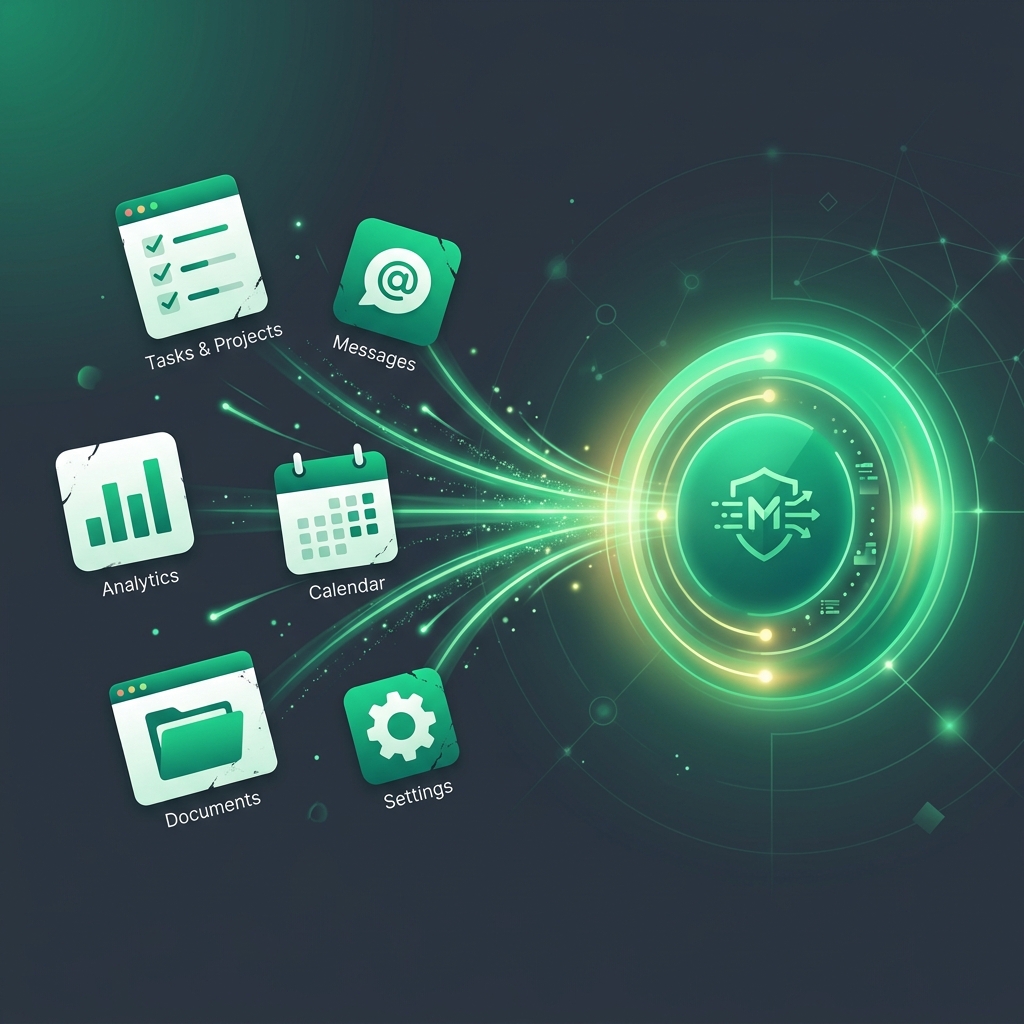
This is exactly why we built TryApprove as an all-in-one platform rather than a single-purpose tool. When onboarding, project management, approvals, feedback, invoicing, and client portal all live in the same system, the manual bridging disappears entirely.
"But Best-of-Breed Tools Are Better at Each Individual Thing"
I hear this objection constantly, and I understand it. DocuSign is an incredible contract tool. Asana is a powerful project management platform. They've had years and billions of dollars of development behind them.
But the comparison is wrong. You're not comparing Tool A vs. Tool B at a specific function. You're comparing the total system performance of a disconnected stack vs. a connected one.
A Formula 1 car has the best engine in the world. But if you disconnect the steering wheel from the front axle, it doesn't matter how good the engine is. You're not going anywhere useful.
The same principle applies to your agency tech stack. Each tool can be individually excellent. But if they don't share data, don't trigger each other, and require humans to manually carry information between them, the total system performance is terrible.
Where "good enough and connected" beats "excellent but isolated"
- Contracts. You don't need 47 contract templates and a legal compliance engine. You need a clean contract that the client can sign digitally, inside the same portal where they'll review work. Good enough and connected.
- File sharing. You don't need 2TB of cloud storage with advanced permissions. You need project-specific file uploads that the client sees instantly in their portal. Good enough and connected.
- Invoicing. You don't need a full accounting suite. You need to generate a professional invoice that's linked to the approved deliverables. Good enough and connected.
- Approvals. You definitely don't need email. You need a button that says "Approve" and a button that says "Request Changes," attached to the actual deliverable, with an audit trail. Good enough and connected.
The 20% of features you lose from each specialized tool is more than offset by the 40% of team capacity you gain by eliminating coordination overhead.
The Migration Playbook: Escaping the 5-Tool Trap
You can't rip out your entire stack overnight, and you shouldn't try. Here's a phased approach:
Phase 1: Map Your Current Workflow (Week 1)
Document every tool touch and manual bridge in your typical project lifecycle. Use this template:
- Step: What happens
- Tool used: Where it happens
- Manual bridge: What a human has to do to move information to the next step
- Time cost: How long the bridge takes
You'll be surprised (and probably frustrated) by how many bridges exist.
Phase 2: Consolidate Client-Facing Ops First (Weeks 2-3)
Start with the workflow your clients see: onboarding, approvals, feedback, and invoicing. This is the highest-leverage move because:
- It immediately improves client experience
- It eliminates the most manual bridges (client-facing ops typically have the most tool-switching)
- It demonstrates ROI fast, which builds internal buy-in for further consolidation
Set up TryApprove for one pilot project. Move the client's contracts, deliverable reviews, approvals, and invoicing into the platform. Measure the difference in cycle time and team hours.
Phase 3: Consolidate Internal Ops (Weeks 4-6)
Once client-facing ops are unified, bring project management and team collaboration into the same system. The goal is one platform where your team manages work and your clients interact with the output — no gap between internal and external.
Phase 4: Deprecate the Old Stack (Week 7+)
Cancel the subscriptions you've replaced. Update your team's onboarding documentation. Run a retrospective after 30 days to measure the impact on:
- Average project cycle time
- Team hours spent on coordination
- Client response time
- Invoice payment speed
The Bottom Line
Your agency's tech stack should be invisible. Not invisible as in "nobody talks about it," but invisible as in "it works so seamlessly that no one has to think about it."
When your tools require constant attention — updating statuses, copying information, sending links, chasing versions — they've become the work instead of supporting the work. And that's the definition of the 5-Tool Trap.
The agencies thriving in 2026 aren't the ones with the most sophisticated tool stack. They're the ones with the most connected tool stack. Often, that means fewer tools, not more.
Consolidate. Eliminate the bridges. Get back to the creative work that actually earns revenue.
Ready to replace five tools with one platform? Start free with TryApprove — onboarding, approvals, invoicing, client portal, and team collaboration in one place. Set up in under two minutes.