
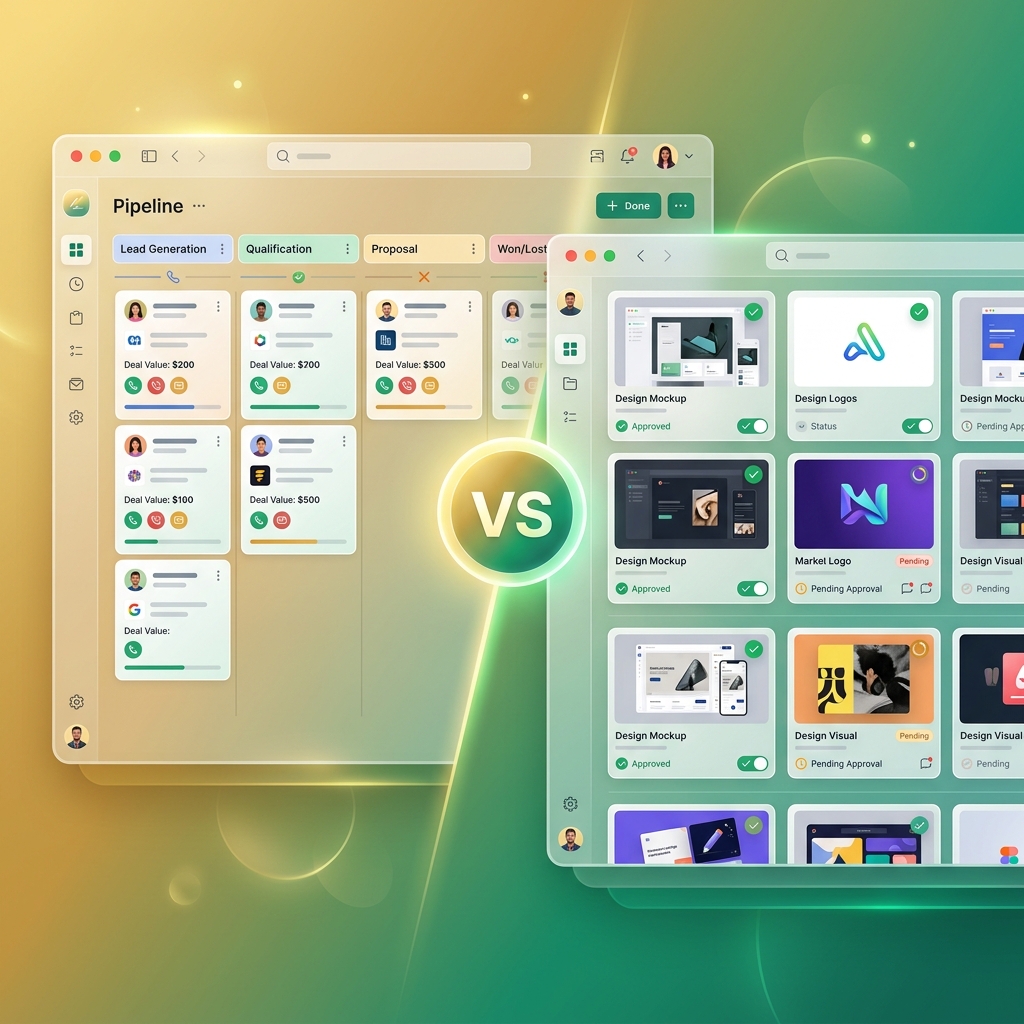
If you've spent any time searching for client management software, HoneyBook has probably shown up in your results. It's well-known, heavily marketed, and popular with photographers, event planners, and solo service providers.
But if you're running a creative agency — managing design deliverables, collecting visual feedback, and coordinating approvals across multiple stakeholders — HoneyBook might not be the right fit. Let me explain why, and where each tool actually shines.
Full disclosure: I'm the founder of TryApprove, so take my perspective with that context. But I'll try to be genuinely fair here, because the right tool depends entirely on your workflow.
What HoneyBook does well
HoneyBook is a CRM and business management platform for independent service providers. It's particularly strong in three areas:
Proposals and contracts
HoneyBook's proposal builder lets you create professional-looking proposals that combine your services, pricing, and contracts into one interactive document. Clients can review, sign, and pay — all in the same flow. This is genuinely well-designed and is a big reason people choose HoneyBook.
Lead management and CRM
HoneyBook has a proper lead pipeline. You can track inquiries, set up automated email sequences, and move prospects through stages. For businesses where lead volume is high and conversion is a priority, this is valuable.
Scheduling and automation
Built-in scheduling (like Calendly) and workflow automations ("when contract is signed, send welcome email after 24 hours") reduce manual follow-up for common business processes.
Where HoneyBook falls short for agencies
Here's where it gets tricky. HoneyBook is designed around a linear service flow: lead comes in → proposal sent → contract signed → payment collected → project delivered. That works beautifully for photographers, wedding planners, and coaches.
But creative agencies have a different workflow. You're not just delivering a one-time service. You're managing ongoing projects with multiple deliverables that need review, feedback, and approval. And that's where HoneyBook starts to struggle.
No visual proofing or annotations
When your client needs to review a homepage design, a social media kit, or a video ad, they need to point at specific elements and tell you what they think. HoneyBook doesn't have this. You'd share a file and then collect feedback through comments, email, or a separate tool.
With TryApprove, clients can annotate directly on images and videos — clicking on the exact spot they're talking about and typing their feedback right there. No more "the thing on the right side, kind of near the middle."
No structured approval workflow
HoneyBook has general "project tracking," but there's no formal approval mechanism for deliverables. There's no "Approve" button the client clicks after reviewing your work. No version history showing what was approved and what was changed.
TryApprove's entire system is built around this: upload a deliverable, share it with the client, they review it and click "Approve" or "Request Changes." It's a clear, documented workflow that eliminates ambiguity.
Limited project management for creative work
HoneyBook's project management is lightweight by design. It's more of a task list than a project management system. For agencies managing multiple tasks per project, multiple versions per deliverable, and multiple stakeholders per review — it gets clunky fast.
Client portal experience
HoneyBook does have a client portal, and it's decent for simple workflows — clients can view their proposals, contracts, and invoices. But it doesn't support the creative review workflow that agencies need. There's no concept of "here are your deliverables, review them, give feedback, approve them."
TryApprove's portal is purpose-built for this: clients open a branded link, see their project status, review deliverables with annotation tools, approve work, and access their contracts and invoices — all without creating an account.
Feature comparison
| Feature | HoneyBook | TryApprove |
|---|---|---|
| Proposals & quotes | ✅ Interactive proposals | ❌ Not built-in |
| Contracts & e-signatures | ✅ Built-in | ✅ Built-in |
| Intake questionnaires | ✅ Smart forms | ✅ Built-in |
| Client portal | ✅ Basic portal | ✅ Full portal (no client signup) |
| Visual proofing & annotations | ❌ | ✅ Images & videos |
| One-click approvals | ❌ | ✅ Approve / Request Changes |
| Version history | ❌ | ✅ Per-deliverable versions |
| Project management | ⚠️ Basic tasks | ✅ Tasks with deliverables |
| Invoicing | ✅ Full invoicing + payments | ✅ Built-in invoicing |
| CRM & lead management | ✅ Full pipeline | ❌ Not built-in |
| Scheduling | ✅ Built-in scheduler | ❌ Not built-in |
| Workflow automations | ✅ Email automations | ⚠️ Basic notifications |
| White-label branding | ⚠️ Limited | ✅ Full white-label (Pro) |
| Client account required | Yes | No |
Pricing comparison
HoneyBook:
- Starter: $19/month (billed annually)
- Essentials: $39/month
- Premium: $79/month
TryApprove:
- Free: $0/month (2 projects, 1 seat)
- Pro: $29/month (billed annually) — unlimited projects, 3 seats, white-label
HoneyBook's pricing is per-business, not per-seat, which is fair. But the starting price for meaningful features ($39/mo Essentials) is higher than TryApprove's Pro plan, which includes unlimited projects and white-label branding.
Also worth noting: TryApprove has a genuinely useful free tier. You can run two full projects with all core features before paying anything.
Who should choose HoneyBook?
HoneyBook is the better choice if:
- You're a solopreneur (photographer, coach, consultant) with a linear service delivery model
- Your priority is lead management and CRM — tracking inquiries, automating follow-ups, managing a pipeline
- You need integrated scheduling for client meetings
- Your deliverables are simple (PDFs, documents) and don't require visual proofing
- You want proposals, contracts, and payments in one flow
Who should choose TryApprove?
TryApprove is the better choice if:
- You're a creative agency or design team managing visual deliverables
- You need clients to review, annotate, and approve designs, videos, or documents
- You want a branded client portal that doesn't require client account creation
- You need project management with multiple tasks and deliverables per project
- You want onboarding, approvals, and invoicing in one platform without the CRM overhead
- Budget matters — TryApprove's Pro plan is cheaper than HoneyBook's Essentials
The bottom line
These are fundamentally different tools for different workflows. HoneyBook is a CRM-first platform for independent service providers. TryApprove is a client-management-first platform for creative teams.
If your business is about booking clients and getting paid, HoneyBook is excellent. If your business is about delivering creative work and getting it approved, TryApprove is purpose-built for that.
The best way to know for sure? Try TryApprove free and test it with a real project. It takes five minutes to set up, and you'll know immediately if it fits your workflow.