
I used to be the bottleneck in my own business, and I didn't even realize it.
Every new project kicked off the same way. A team member would ping me: "Hey, how do we handle X again?" I'd explain the process over Slack, they'd execute it, and three weeks later someone else would ask me the exact same question. I was a human FAQ machine, burning hours every week answering things I'd already answered a dozen times.
That changed the day I wrote my first SOP. It was ugly. It was a Google Doc with bullet points and screenshots that looked like it was formatted by someone who'd never heard of headings. But it worked. The next time someone asked "how do we handle X," I just dropped the link. Ten seconds instead of ten minutes.
That single document saved me more time in a month than I'd spent creating it. And that was when I realized: if you run a creative agency and you don't have SOPs, you don't have a scalable business. You have a job that happens to employ other people.
What Is an SOP, Really?
A Standard Operating Procedure is just a fancy name for "written instructions on how to do a thing." That's it. No corporate jargon required.
Think of it as a recipe. A great restaurant doesn't rely on the chef remembering how much salt goes in the risotto. They write it down, step by step, so that any competent cook can produce a consistent result. Your agency needs the same thing for its repeatable processes.
A good SOP answers three questions:
- What needs to happen? The sequence of steps.
- Who is responsible? The role (not the person) that owns each step.
- What does "done" look like? The clear definition of a completed task.
If your process documentation doesn't answer all three, it's not an SOP. It's a suggestion.
Why Most Creative Agencies Resist SOPs (And Why They're Wrong)
There's a common objection I hear from agency owners: "We're a creative business. SOPs will kill the magic."
I understand the instinct, but it's backwards.
SOPs don't constrain creativity. They protect it. When your team doesn't have to waste mental energy figuring out how to name files, where to upload deliverables, or what the approval workflow is, they have more brainpower left for the actual creative work.
Here's the irony: the agencies that produce the most consistently excellent creative work are usually the most operationally disciplined. They have systems for the boring stuff precisely because they take the creative stuff seriously.
The chaos isn't charming. It's expensive. Every time a file gets lost, a brief gets misunderstood, or a client review falls through the cracks, your agency loses money. SOPs are how you stop the bleeding.
The 5 SOPs Every Creative Agency Needs First
You don't need to document everything. Start with the processes that cause the most friction, cost the most money, or happen the most frequently.
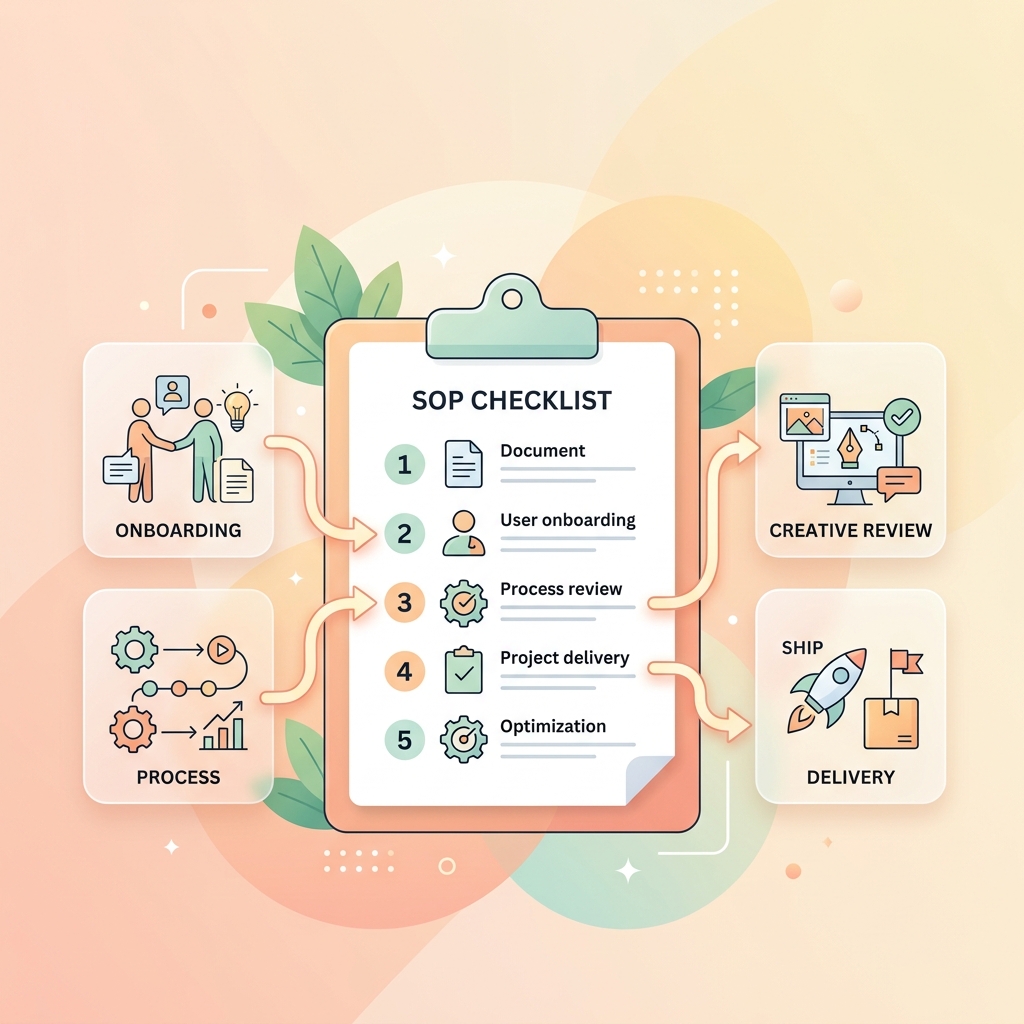
For most agencies under 15 people, these five will cover 80% of your operational pain:
1. Client Onboarding
This is where first impressions are made. Your onboarding SOP should cover:
- Contract and payment setup. Who sends the contract? What happens after it's signed? When does invoicing begin?
- Asset collection. How do you request brand guidelines, logins, existing content, and other materials from the client? What's the follow-up cadence if they don't send them?
- Kickoff call structure. What questions do you ask? What do you present? Who takes notes, and where are those notes stored?
- Internal project setup. Creating the project in your PM tool, setting up folders, adding team members, and establishing communication channels.
The goal is that any team member can onboard a new client by following the document, without needing to ask you a single question.
2. Creative Review and Approval
This is the process that breaks most agencies. Vague feedback over email, missed deadlines, conflicting comments from multiple stakeholders, and zero documentation of what was actually approved.
Your review and approval SOP should define:
- How deliverables are shared. Not "email the files." A specific tool, a specific format, a specific naming convention.
- How feedback is collected. Structured comments tied to specific elements, not open-ended emails.
- What constitutes approval. A defined action (clicking "Approve") versus a vague "looks good" in a Slack message.
- Revision limits. How many rounds of revisions are included, and what happens when you exceed them.
If your current approval process involves sending ZIP files over email and hoping for the best, building this SOP will save you more time than any other on this list.
3. Project Delivery
The moment between "the work is done" and "the client has received everything" is where many agencies drop the ball. Your delivery SOP should include:
- Final quality checklist. Does the design match the approved mockup? Are all files in the correct formats? Are assets organized logically?
- Packaging standards. How are files named, organized, and compressed for delivery?
- Delivery method. Where and how the client receives the final work.
- Post-delivery follow-up. Who checks in with the client after delivery to confirm satisfaction?
4. Internal Communication
This SOP doesn't need to be long, but it needs to exist. It defines:
- What goes where. Project updates in the PM tool, quick questions in Slack, strategy discussions in scheduled calls. No exceptions.
- Response time expectations. Team members respond to Slack messages within 4 hours. PM tool comments within 24 hours. Emergencies go to phone.
- Meeting cadence. Weekly standups, monthly retrospectives, quarterly planning. When they happen, how long they last, and what's discussed.
The reason you need this written down is that "common sense" is never as common as you think. What feels obvious to you is not obvious to the person you hired last month.
5. New Team Member Onboarding
Every time you hire someone new, you shouldn't have to personally walk them through every tool, process, and expectation from scratch. Your employee onboarding SOP should include:
- Day 1 checklist. Accounts to create, tools to install, documents to read, people to meet.
- Week 1 goals. Small tasks that help them learn the workflow by doing, not just reading.
- Key resources. Links to your other SOPs, brand guidelines, communication norms, and project examples.
A new hire who can self-onboard in three days instead of two weeks isn't just more efficient. They're more confident, more independent, and more likely to stay.
How to Actually Write an SOP (Without Spending Your Weekend on It)
The biggest mistake people make with SOPs is treating them like a writing assignment. They sit down, open a blank document, and try to write the perfect process guide from memory. Then they get overwhelmed, close the document, and never come back to it.
Here's a better approach.
The "Record and Transcribe" Method
-
Pick one process. Start with the one that annoys you the most. The one where you think "I shouldn't have to explain this again."
-
Do the process yourself and record your screen. Use Loom, or any screen recording tool. Talk through what you're doing and why as you do it. Don't script it. Just narrate naturally.
-
Transcribe it. Watch the recording and turn your narration into numbered steps. Cut the rambling, keep the instructions.
-
Add screenshots. Go back and grab screenshots of the key moments. A five-second screenshot saves five minutes of written description.
-
Test it. Hand the SOP to a team member who hasn't done this task before. Watch them follow it. Where they get stuck, the SOP needs improvement. Where they breeze through, you're done.
This entire process takes about 45 minutes per SOP. That's less time than you'll spend this month answering Slack messages about the same process.
Where to Store Your SOPs
The best SOP is the one your team can actually find. Store them wherever your team already works:
- Notion is excellent for agencies that like flexible, linked documentation.
- Google Docs works fine if you organize them into clearly labeled folders.
- Your PM tool is ideal if it supports docs or wikis, because the SOPs live next to the work.
The worst place to store SOPs is in a folder called "SOPs" that nobody knows exists. Put them where people already look.
The Biggest Mistake: Writing SOPs and Forgetting About Them
A stale SOP is worse than no SOP, because people follow outdated instructions and produce incorrect work while believing they did it right.
SOPs are living documents. Build a simple maintenance habit:
- When you change a tool or process, update the relevant SOP immediately. Make it part of the rollout, not an afterthought.
- Every quarter, review your top five SOPs. Ask your team: "Is this still accurate? What's missing?"
- When something goes wrong, check the SOP first. If the SOP was correct and the person didn't follow it, that's a training issue. If the SOP was wrong or incomplete, that's a documentation issue. Both are fixable. Neither requires yelling.
SOPs Don't Kill Creativity. Chaos Does.
The agencies that produce consistently great work aren't the ones with the most talented individuals. They're the ones where talented people don't waste half their day on administrative confusion.
Building SOPs is not glamorous work. Nobody became an agency owner because they dreamed of writing process documents. But the agency owners who do this work are the ones who eventually stop working weekends, stop being the bottleneck, and start leading instead of firefighting.
Start with one SOP this week. Pick the process that's been bugging you the most. Record yourself doing it. Write it down. Share it with your team.
Then do it again next week. Five SOPs in five weeks will transform how your agency operates. I'm not exaggerating.
If your approval process is one of the things you need to systematize, TryApprove can help. It replaces the chaos of email-based feedback with a structured portal where clients review, comment, and approve — all in one place, no sign-ups required.
Already have SOPs in place? Read about how to build a client approval process that complements your operational framework.